
Can You Change Your Hair Type With Surgery?
Every hair type is unique. There are a lot of concerns from people who are afraid of hair transplant procedures because they might change their ethnic hair types . Some people experience a change in their hair texture after undergoing a hair transplant surgery. However, a change in hair type is unlikely. If you have curly hair, your hair will not be straight after the hair transplant procedure. Because the hair that grows after the surgery is your hair, too. It is rather the hair texture that is prone to change.
Your natural hair type cannot be permanently changed without chemical intervention, because hair texture is hardcoded into the shape of your hair follicles by genetics. Round follicles produce straight hair, oval follicles produce wavy hair, and asymmetrical or hooked follicles produce curly and coily strands. Surgery, including hair transplantation, does not rewrite follicular shape, but it can introduce hair from a different region of your scalp that grows in with a slightly different curl pattern or thickness.
What Are the Main Hair Types?
Hair types are classified into four core categories using a 1 through 4 system: type 1 is straight, type 2 is wavy, type 3 is curly, and type 4 is coily. The classification is governed by follicle shape, which is genetic and visible under microscopy.
Hair Type Overview: Follicle Shape & Key Traits
| Hair Type | Follicle Shape | Pattern | Key Trait |
|---|---|---|---|
| Type 1 (Straight) | Round | Flat, no curl | Oily faster, high shine |
| Type 2 (Wavy) | Slightly oval | S-shaped waves | Frizz-prone, medium body |
| Type 3 (Curly) | Elliptical, angled | Ringlets to corkscrews | High shrinkage, defined curls |
| Type 4 (Coily) | Hooked, asymmetrical | Tight zigzag coils | Most fragile, highest shrinkage |
Each main type also splits into A, B, and C subcategories based on strand diameter and curl tightness. Other key factors include:
- Type 1 (Straight): Grown from perfectly round follicles, this hair lies flat against the scalp, reflects light easily, and tends to become oily faster because sebum travels down the shaft without obstruction.
- Type 2 (Wavy): Produced by slightly oval follicles, with an S-shaped pattern that ranges from loose beach waves (2A) to defined waves with a tendency to frizz (2C).
- Type 3 (Curly): Spirals form when the follicle is more elliptical and angled, creating ringlets from loose corkscrews (3A) to tight, springy curls (3C).
- Type 4 (Coily): Hooked or sharply asymmetrical follicles create tight zigzag patterns, dense coils, or fragile micro-curls with high shrinkage rates.
- Strand thickness and density: These vary independently of curl pattern, meaning two people with type 3B curls can have completely different volume and behaviour.
Understanding your true type matters because every product, treatment, and styling decision should match the structure your follicles produce naturally.
Is It Possible to Change Your Hair Type?
You cannot change your hair type permanently through natural means, because the follicle shape that dictates curl pattern is set by your DNA. Anyone wondering whether you can change your hair type naturally will find that brushing, oiling, masking, or switching shampoos may improve hydration, shine, and elasticity, but none of those rituals reshape the follicle itself. What does shift naturally is the appearance of texture: a curl can look looser when weighed down by deep conditioner, and straight hair can appear wavier in humidity.
Real, lasting change only happens through chemical processes that break and reform the disulphide bonds inside each strand, or through surgical relocation of follicles from a donor area that grows hair with a different texture. So when people ask whether you can change your hair type permanently without chemicals, the answer remains no, only the visible behaviour of your strands can be temporarily manipulated.
Can Age Impact Your Hair Texture?
Yes, age changes hair texture multiple times across a lifetime, and these shifts are biological rather than cosmetic. Children are often born with fine, straight, or loosely wavy hair that develops more curl and density during puberty as androgen levels rise and follicle shape matures. In your twenties and thirties, texture usually stabilises, but pregnancy, postpartum hormonal drops, and stress can temporarily alter strand diameter and curl tightness. From your forties onward, follicles begin to shrink, producing finer strands, and the cuticle layer thins, making hair feel rougher even if the curl pattern stays the same.
Greying compounds this, because grey strands lack melanin and retain less moisture, which often makes them coarser, wirier, and more resistant to styling than the pigmented strands around them. So when you ask whether your hair type can change over the decades, the honest answer is that it absolutely does, the texture you have at fifty is rarely the texture you had at fifteen.
Can Hormones Affect Your Hair Texture?
Hormones are one of the most powerful drivers of hair texture change, often producing visible shifts within a single year. Pregnancy raises oestrogen levels, which extends the growth phase of the hair cycle and can make strands feel thicker, glossier, and even straighter than usual. Postpartum, oestrogen drops sharply, triggering shedding and frequently a return to a different texture than what existed before pregnancy, sometimes curlier, sometimes flatter. Thyroid imbalances, both hyper and hypo, alter strand diameter and elasticity, while polycystic ovary syndrome elevates androgens that can coarsen scalp hair while thinning the crown.
Menopause lowers oestrogen and progesterone, which is why many women in their fifties report finer, drier, and frizzier hair even when their curl pattern looks similar. The follicle shape itself doesn't fully transform, but the proteins it produces do, which is why hormonal shifts so often partially answer the question of whether you can permanently change your hair type, through internal biology rather than external products.
Are Chemical Changes to Hair Texture Permanent?
Chemical changes are permanent only on the strands they touch, lasting until that hair is cut off or grows out from the root. A keratin treatment, also called a Brazilian blowout, smooths and straightens hair using a flat iron to seal the formula, and the result typically lasts between three and six months before fading. A perm wraps hair around rods and applies a solution that breaks and reforms the disulphide bonds into waves or curls, holding for six to eight months.
A texturizer softens and loosens tight coils, lasting about three months before regrowth becomes visible at the root. Relaxers permanently straighten the treated section, but new growth always emerges in your natural texture, which is why touch-ups are needed every couple of months. So while chemistry genuinely addresses whether you can change your hair texture permanently for the strand in question, your follicle keeps producing your original hair type regardless of how many times you treat it.
Can a Hair Transplant Change Hair Texture?
A hair transplant can change the texture of hair growing in the recipient area, because surgeons relocate follicles from a donor zone, usually the back and sides of the scalp, where the hair often differs slightly from that of the crown or hairline. If your donor hair is coarser, wavier, or denser than the thinning area, the transplanted follicles will continue to produce their original texture in their new location, creating a subtle blend rather than an exact match. Modern FUE Hair Transplant and DHI techniques preserve follicle integrity, so the relocated hair grows with the same curl pattern, diameter, and growth angle it had in the donor zone. This is the closest answer to whether you can change your hair type with surgery, because surgery moves follicles but does not reshape them. Patients with curly or Afro-textured hair require surgeons trained specifically in curved follicle extraction, since the curl pattern continues below the scalp surface and an incorrect tool angle damages graft survival rates.
The transplanted hair is permanent, sheds once during the initial four-to-six-week phase, then regrows steadily, reaching its final texture and density between twelve and eighteen months after surgery.
An FUE hair transplant is one of the most common hair transplant procedures. During an FUE hair transplant surgery, the healthy hair follicles are taken typically from the back of your scalp to be implanted in the area where hair loss occurred. So, the texture or the color of your hair after the hair transplant is actually determined by the donor area where the follicles are taken from. For example, if the donor area has blond curly hair, you will have blond curly hair after the transplant. Frequently, the texture of hair also stays the same. However, in some cases of trauma that the scalp experiences, the texture of hair might change after the hair transplant surgery. However, even in such cases, hair texture usually changes back to its original form after 1 or 2 years. Some people have concerns about Afro hair transplant and that the hair transplant surgery will change their hair completely. If you have such concerns, you should consider discussing them with a doctor thoroughly.
Each of us has a unique texture or type of hair. Each ethnic group has different qualities of hair. It might sound scary for many people that their hair type will change when it grows again. If you have such concerns and questions, feel free to contact the specialists in Asmed. You might also be questioning how to choose a hair transplant clinic in Turkey. Here, at Asmed, we do our best to make sure your hair transplant in Istanbul becomes successful but also comfortable and reassuring regarding your concerns.
At ASMED Hair Transplant Center, Dr. Koray Erdogan utilizes the revolutionary KE-Bot and K.E.E.P. (Koray Erdogan Embedding Placer) systems to ensure that each follicle is handled with surgical precision. This precision is the key to reconstructing a natural hairline with the correct density and direction. ASMED's expertise in complex hair types ensures that the integrity of even the most delicate follicles is protected. By employing these advanced technologies, ASMED ensures that the natural characteristics of your donor hair are maintained throughout the relocation process, providing a seamless and natural-looking hair transplant result.
Get a Free Consultation!
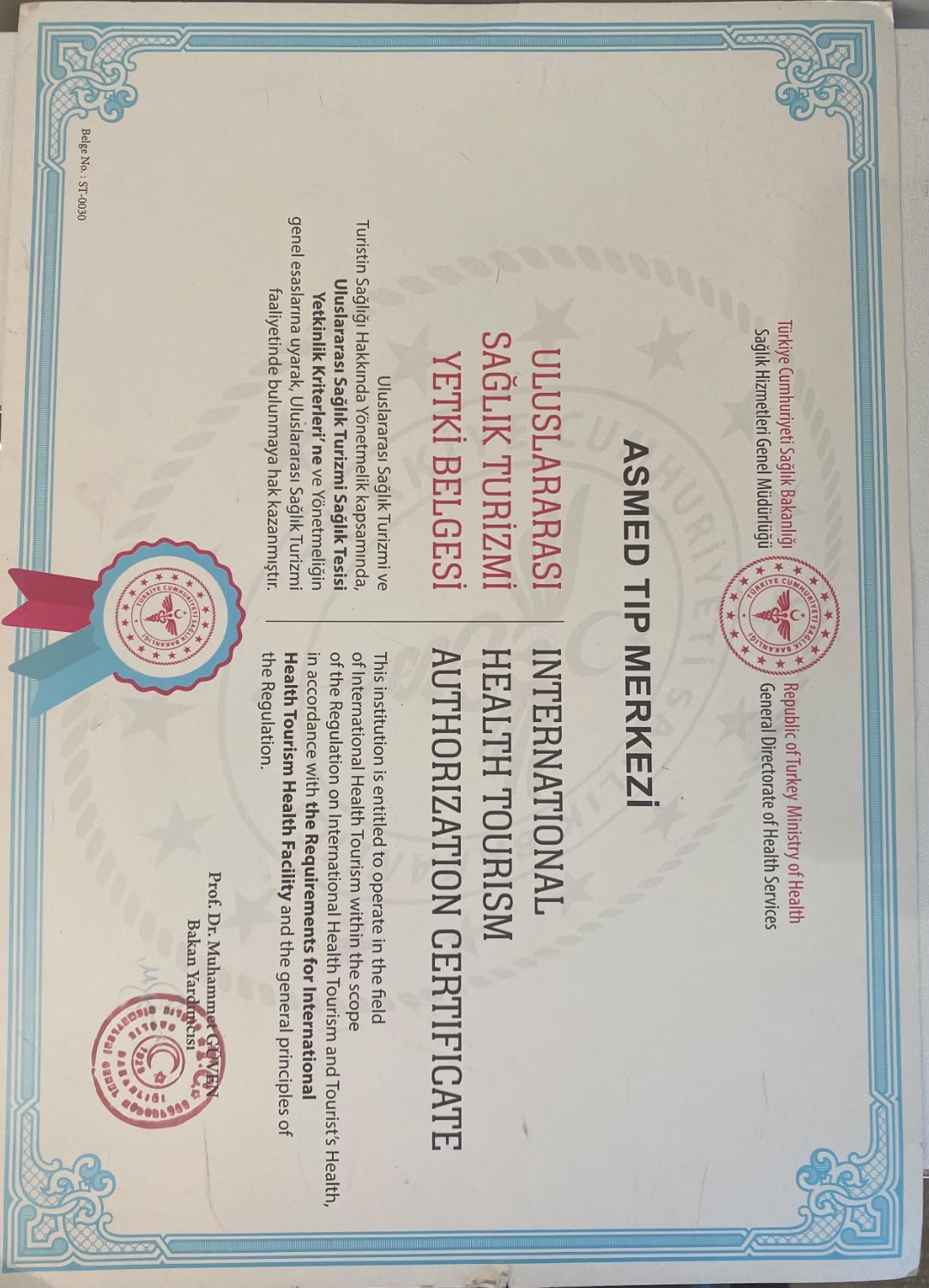
Uluslararası Sağlık Turizmi Yetkili Sağlık Tesisi
ASMED Tıp Merkezi, T.C. Sağlık Bakanlığı tarafından uluslararası sağlık turizmi alanında hizmet sunmak üzere yetkilendirilmiş bir sağlık tesisidir.
Sağlık Tesisi Sahibi: ASMED ÖZEL SAÇ EKİMİ SAĞLIK HİZMETLERİ A.Ş.
Yetki Belgesi No: ST-0030
International Health Tourism Authorized Healthcare Facility
ASMED Medical Center is a healthcare facility authorized by the Republic of Türkiye Ministry of Health to provide services in the field of international health tourism.
Owner and Operator: ASMED ÖZEL SAÇ EKİMİ SAĞLIK HİZMETLERİ A.Ş.
Authorization Certificate No.: ST-0030

Atatürk Mah. Sedef Caddesi No: 1/1 Ataşehir - İstanbul
Cookie Declaration - Update Date: 09.09.2026 - Editor: Ozer Erik - Tel: +90 216 464 11 11