FUE: A Guide to Successful Hair Restoration - Asmed
Accurate donor-hair assessment, an extraction plan and recipient-area design form the foundation of natural-looking FUE results. A quoted success percentage needs to explain what was measured, in which patients and at what point after surgery. It cannot predict an individual result on its own.
FUE (Follicular Unit Extraction) describes the removal of follicular grafts individually from the donor area. The outcome also depends on how those grafts are handled and placed, how the scalp heals, and how continuing hair loss is planned for.
Is FUE Hair Transplant Successful?
For someone considering FUE, useful outcomes include growth from the transplanted follicles, natural hair direction, appropriate coverage and the appearance of the remaining donor hair. These are related, but they answer different questions.
If a clinic gives a graft survival rate, ask how growth was counted and when it was assessed. A patient satisfaction figure measures something different. Our guide to hair transplant success rates explains these distinctions in more detail.
What Affects the Result of FUE?
During extraction, the punch needs to follow the position and direction of the follicles below the skin. Accidentally cutting a follicle during extraction is called transection and can affect the graft’s growth potential. The ISHRS explanation of FUE extraction describes why protecting the follicles matters. A low transection figure alone does not establish the final survival rate after implantation.
The donor area also needs a plan for the hair left behind. Taking more grafts can increase the number available for implantation while reducing donor density. Distribution across suitable donor regions, hair characteristics and possible future procedures all belong in that assessment.
At ASMED, Manual FUE uses a hand-operated punch, with punch size and extraction depth adapted to the individual hair characteristics. Dr. Koray Erdoğan personally creates the recipient sites, planning their direction and angle as part of the intended natural appearance.
Grafts are placed individually into the pre-created recipient sites using K.E.E.P. (Koray Erdoğan Embedding Placer), an instrument developed by Dr. Erdoğan for precise and controlled graft placement.
How Does FUE Compare with FUT?
FUE and FUT are different ways of obtaining donor grafts. FUE does not involve the linear incision and sutures used in FUT strip harvesting. Planning considers donor characteristics, previous surgery, hairstyle preferences and the longer-term plan. Read our FUE and FUT comparison for the practical differences to discuss with your doctor.
When Should FUE Results Be Reviewed?
Transplanted hair shafts commonly shed during the first weeks, before new growth becomes visible over the following months. The American Academy of Dermatology notes that many patients see results at six to nine months. Growth and maturation continue, and the final appearance is generally assessed over 12–18 months, with individual variation.
Compare progress photographs with similar lighting, angles and hair length. Include the donor area as well as the hairline and coverage. Follow the washing, activity and scalp-care advice in ASMED’s postoperative instructions and the individual instructions given for your procedure.
At ASMED, the first hair wash takes place the day after surgery, and the scalp is checked before departure. Patient coordinators support patients during a 12–15-month follow-up period, with clinical concerns referred to doctors.
A second procedure may be considered for additional coverage or later hair loss, depending on the first result and remaining donor capacity. It should be planned after an individual review rather than treated as an automatic part of FUE.
How Much Does an FUE Hair Transplant Cost?
The proposed graft count and treatment plan affect the cost. ASMED’s hair transplant cost page explains the published surgical fee and the information to confirm in your individual quotation.
Hair transplant decisions can feel confusing. At ASMED, our priority is to help you understand your hair loss and the options available to you. Start with an online consultation to discuss your donor hair, the areas you want to improve and the result you hope to achieve.
Get a Free Consultation!
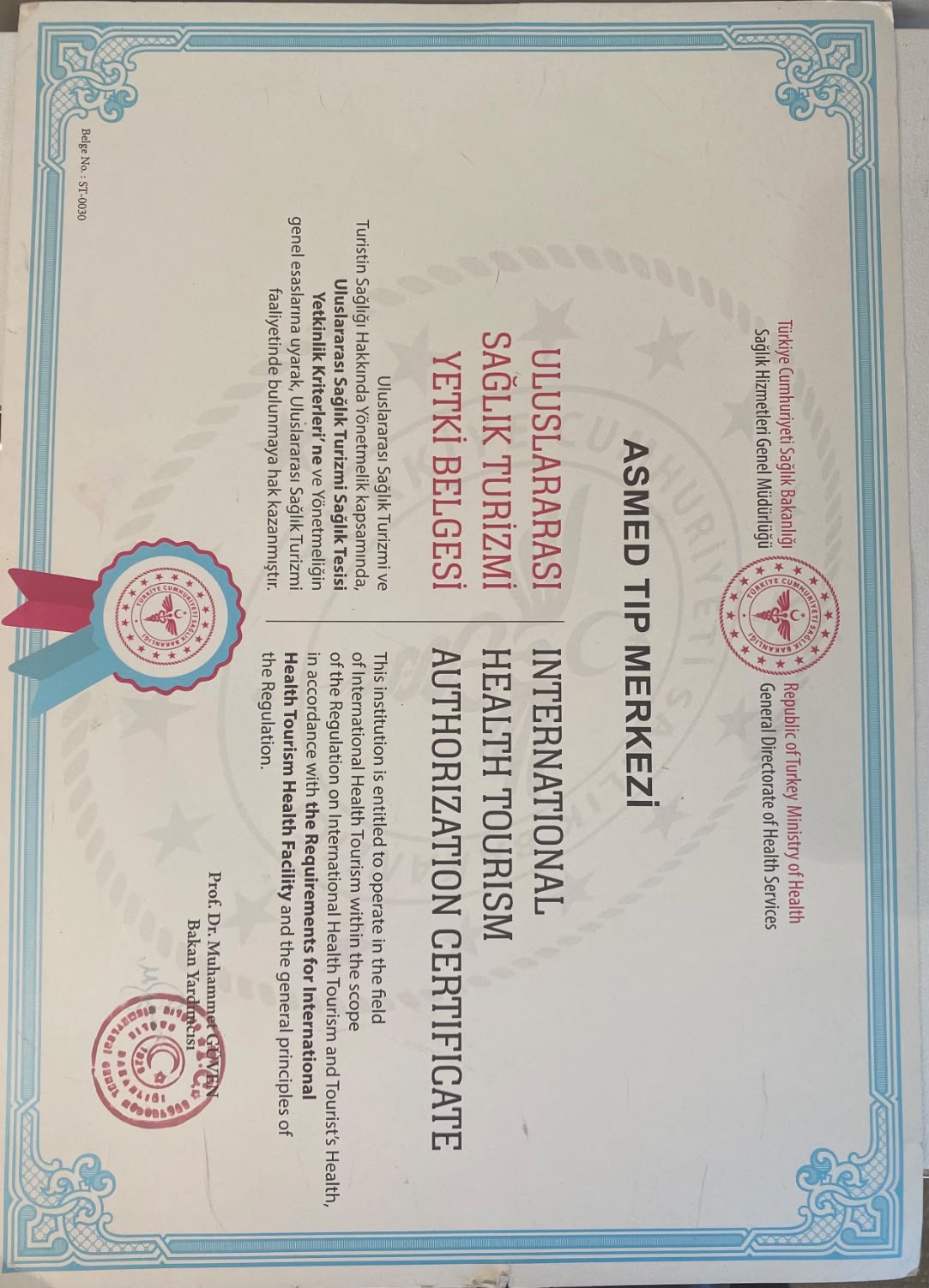
Uluslararası Sağlık Turizmi Yetkili Sağlık Tesisi
ASMED Tıp Merkezi, T.C. Sağlık Bakanlığı tarafından uluslararası sağlık turizmi alanında hizmet sunmak üzere yetkilendirilmiş bir sağlık tesisidir.
Sağlık Tesisi Sahibi: ASMED ÖZEL SAÇ EKİMİ SAĞLIK HİZMETLERİ TİCARET A.Ş.
Yetki Belgesi No: ST-0030
International Health Tourism Authorized Healthcare Facility
ASMED Medical Center is a healthcare facility authorized by the Republic of Türkiye Ministry of Health to provide services in the field of international health tourism.
Owner and Operator: ASMED ÖZEL SAÇ EKİMİ SAĞLIK HİZMETLERİ TİCARET A.Ş.
Authorization Certificate No.: ST-0030

Atatürk Mah. Sedef Caddesi No: 1/1 Ataşehir - İstanbul
Cookie Declaration - Update Date: 23.11.2026 - Editor: Ozer Erik - Tel: +90 216 464 11 11