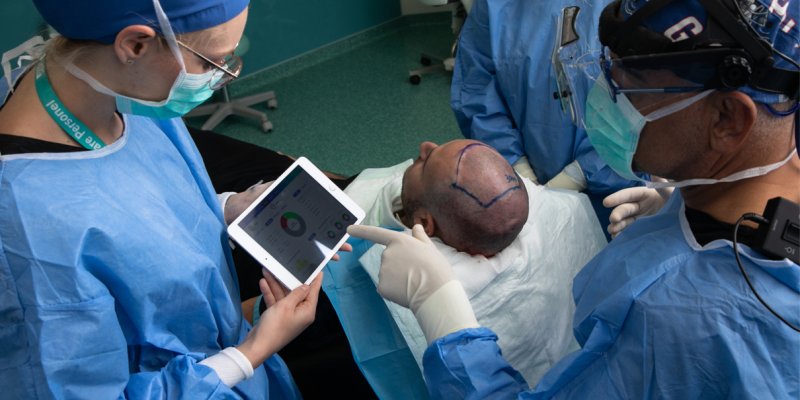
8000 Grafts Hair Transplant in Turkey: Costs and Results
When people who consider a hair transplant operation get in touch with a professional, one of the most frequently asked questions is “how many hair grafts will I need for my hair transplant surgery?” Because the amount of hair transplants required is dependent on various factors and varies from person to person, there is no fixed answer to this question. The number of hair grafts needed for your hair transplant surgery could only be determined after a trained surgeon analyzes your hair type and hair density in the donor area.
Before undergoing a hair transplant procedure, it is critical to understand hair grafts and what they are. So, what is a hair graft? Your hair grows in groups of one, two, three, or even four strands. Hair grafts are simply groups of hair strands. During a hair transplant operation, the donor area, which is usually the back of the head, is used to remove hair grafts. In one sitting, around 2000 grafts could be transplanted with the FUE method.
For some patients, the donor area might not have enough hair grafts to complete a hair transplant surgery, so, you should consult your doctor before determining the hair transplant process. Your doctor will explain to you what kind of surgery you will need and how many hair grafts are needed for the operation.
What is an 8000 Graft Hair Transplant?
An 8000 grafts hair transplant targets the most advanced hair loss patterns (often Norwood 6–7). A “graft” is a follicular unit with 1–4 hairs; thus, 8000 grafts may restore 16,000–20,000+ hairs depending on hair caliber and grouping. With FUE 8000 grafts, follicles are extracted one by one from safe donor zones (occipital/parietal) and implanted to reconstruct the hairline, mid-scalp, and crown with strategic density. Because 8000 is a very high count, candidacy hinges on donor density, hair shaft thickness, scalp laxity, and long-term planning to keep a natural, balanced look. It can be considered options like a 1000 graft hair transplant or 5000 graft hair transplant according to your situation.
8000 Grafts FUE Hair Transplant Cost in Turkey
The 8000 grafts hair transplant cost Turkey patients see is typically packaged—covering pre-op assessment, anesthesia, medications, washes, and follow-ups. Some clinics charge per graft, others offer fixed packages. While prices vary by surgeon expertise and inclusions, Turkey generally provides world-class skill at competitive rates, making the 8000 grafts hair transplant cost more attainable than in many Western countries. Always confirm what’s included (PRP, lodging, transfers, interpreters) and who performs the critical steps to ensure that the fee reflects true surgical quality.
Advantages of 8000 Grafts Hair Transplant in Turkey
- High-volume expertise: Turkish teams routinely handle complex FUE 8000 grafts cases requiring meticulous planning.
- Technology & techniques: Sapphire blades, implanter pens, and refined FUE workflows minimize scarring and maximize survival.
- Value & convenience: Competitive pricing plus medical-tourism infrastructure keeps the 8000 grafts hair transplant cost Turkey travel-friendly.
- Proven results: Clinics share extensive 8000 grafts hair transplant before and after galleries for transparency and expectation-setting.
How Many Hair Grafts Will I Need for a Hair Transplant Operation?
As mentioned before, your doctor will analyze the characteristics of your hair loss and a few other factors before determining the number of hair grafts needed for a successful hair transplant surgery for you. Simply put, the number of hair grafts needed for a hair transplant depends on the size of the balding area, the level and type of hair loss, the quality of the patient’s hair, the type of hair transplant method chosen, and the patient’s budget.
How Long After a Hair Transplant Are the Grafts Secure?
Another commonly asked question for hair transplants is “how long after hair transplant are grafts secure?”. Typically, between 10 and 14 days after transplantation, newly transplanted hair grafts are secure in their new place on the scalp. The newly transplanted grafts need some time to adapt to their new location. During this adaptation, some hair grafts might be knocked out and fall out. However, this is very normal and your grafts will become secure in a short time.
Is 8000 Graft Hair Transplant Enough?
“Enough” depends on your pattern, goals, and donor supply. For many severe cases, 8000 grafts can comprehensively rebuild the hairline and mid-scalp and provide meaningful crown coverage. However, ultra-high sessions must protect donor reserves and achieve consistent density—not just a dense front with a sparse crown. An experienced surgeon may stage the crown or adjust distribution to prioritize a natural frame and long-term sustainability.
What Is the Cost of a Hair Transplant in Turkey?
The hair transplant cost per graft in Turkey is typically between 2$ and 10$. However, this number could vary from surgeon to surgeon and patient to patient. As previously mentioned, the calculation of the cost of a hair transplant is made according to the number of hair grafts needed for the surgery. Therefore, it is difficult to suggest a certain price for the surgery. So, it is not possible to answer the question “how much do 3000 grafts cost in Turkey?” without you being examined by a doctor.
Fortunately, compared to other European countries, Turkey is a lot cheaper when it comes to hair transplant operations. This is because of the higher living costs in those countries. So, cheaper hair transplants in Turkey do not mean the quality of the surgery is lower.
Is an 8000 Grafts Hair Transplant in Turkey Right For You?
Ideal candidates have robust donor density, stable hair loss, and realistic expectations. Pre-op photos, trichoscopy, and coverage-value analysis help predict outcomes. Medical therapy (e.g., finasteride/minoxidil where appropriate) supports the transplant long term. If your donor capacity is borderline, a tailored plan—sometimes combining beard/body hair—may be considered, but scalp-to-scalp remains the gold standard for texture match and aesthetics.
8000 Graft Hair Transplant Results in Turkey
Expect early sprouts at months 3–4, visible thickening by month 6–8, and maturation around 12–15 months. The best 8000 grafts hair transplant before and after cases show a natural hairline design, consistent density across the frontal/mid-scalp, and a crown that blends seamlessly. Results hinge on graft handling, placement angles, anesthesia time management, and diligent aftercare (wash protocol, sleep position, sun/smoke avoidance).
At ASMED Surgical Medical Center, we help patients look—and feel—their best by pairing advanced FUE (Follicular Unit Extraction) with digital scalp analysis and precise Coverage Value calculations. From the KE-Bot robotic scanning system to the K.E.E.P. embedding placer, Dr. Koray Erdoğan’s innovations enable real-time surgical adjustments that create a refined, homogeneous, and natural appearance. Our scientific, mathematical, and artistic methodology—backed by state-of-the-art tools—drives the accuracy and consistency that patients envision, positioning ASMED among Turkey’s leading clinics and a recognized global pioneer in hair restoration. We unite evidence-based practice with continuous training, patient education, and full-team engagement—while keeping costs within the market range. In a space crowded with misinformation, our mission is to inform your choices and keep advancing techniques that expand what’s possible. Most importantly, our goal never changes: delivering life-changing results.
If you are considering a hair transplant operation and have questions and doubts, it is important to consult professionals for correct information. In Asmed, you could be sure that your questions will be answered thoroughly, and you will be updated for every step of your procedure. All of the staff in Asmed is trained for any kind of problem that might occur and take important precautions for these. Your health and satisfaction are the utmost priority in Asmed. You could easily contact the Asmed personnel for more information about hair health and hair transplant operations.
Get a Free Consultation!
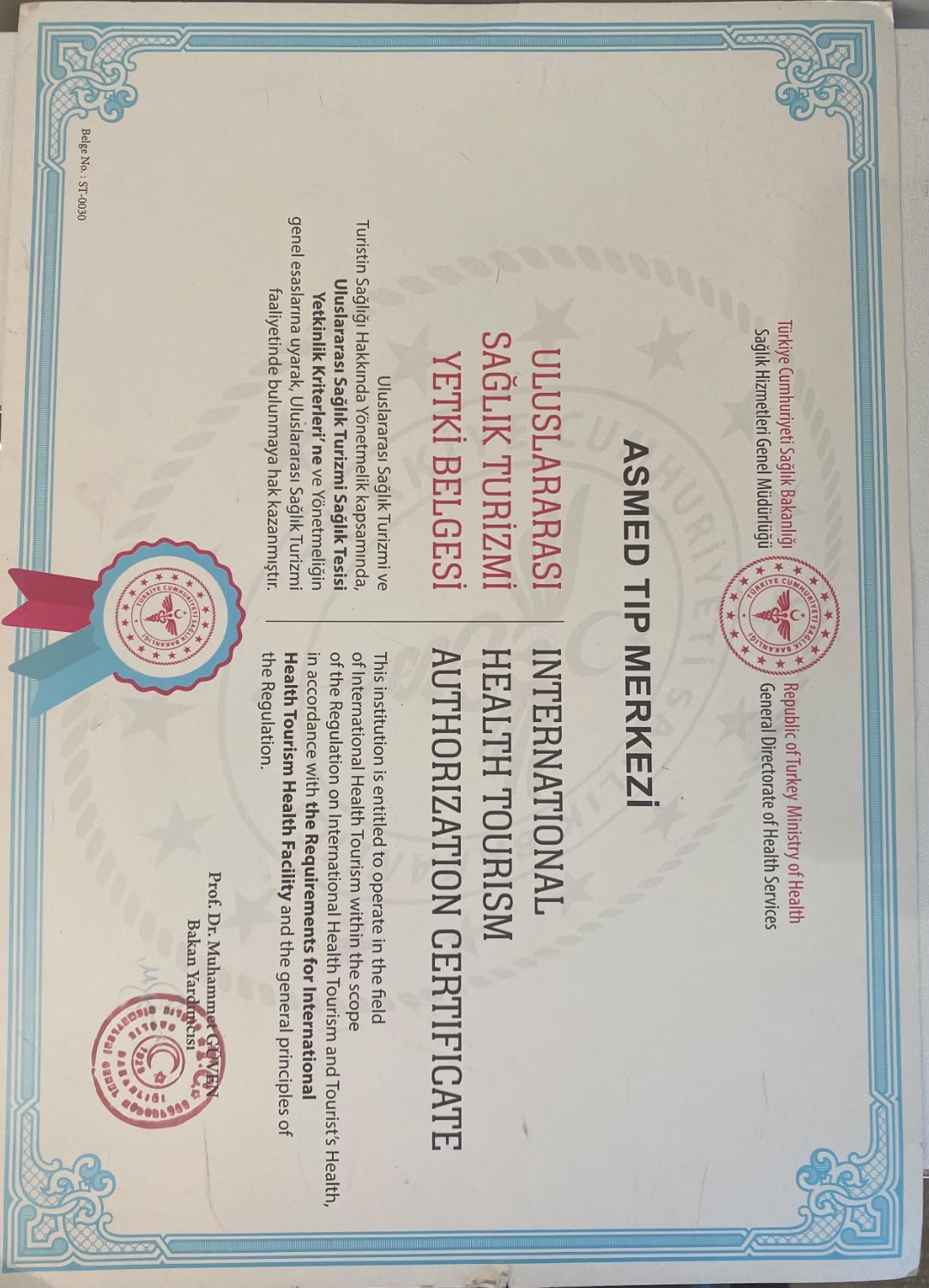
Uluslararası Sağlık Turizmi Yetkili Sağlık Tesisi
ASMED Tıp Merkezi, T.C. Sağlık Bakanlığı tarafından uluslararası sağlık turizmi alanında hizmet sunmak üzere yetkilendirilmiş bir sağlık tesisidir.
Sağlık Tesisi Sahibi: ASMED ÖZEL SAÇ EKİMİ SAĞLIK HİZMETLERİ A.Ş.
Yetki Belgesi No: ST-0030
International Health Tourism Authorized Healthcare Facility
ASMED Medical Center is a healthcare facility authorized by the Republic of Türkiye Ministry of Health to provide services in the field of international health tourism.
Owner and Operator: ASMED ÖZEL SAÇ EKİMİ SAĞLIK HİZMETLERİ A.Ş.
Authorization Certificate No.: ST-0030

Atatürk Mah. Sedef Caddesi No: 1/1 Ataşehir - İstanbul
Cookie Declaration - Update Date: 09.09.2026 - Editor: Ozer Erik - Tel: +90 216 464 11 11