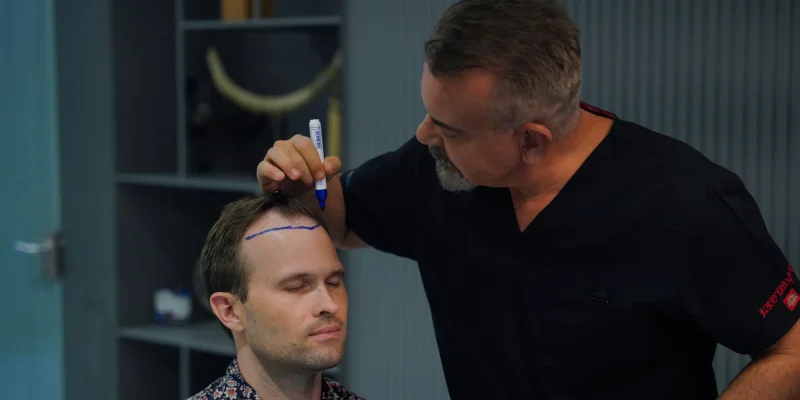
Hair Transplant Approach
Hair Transplantation at ASMED: Dr. Koray Erdoğan’s Approach
At ASMED Surgical Medical Center in Istanbul, Turkey, Dr. Koray Erdoğan combines individualized hairline design with meticulous donor planning. He assesses hair density and thickness across donor regions to plan the amount and distribution of Manual FUE extraction. The aim is to restore natural-looking coverage while preserving an even appearance in the donor area and considering the reserve that may be needed for future treatment.
Designing a natural hairline and restoring coverage
Dr. Erdoğan designs the hairline around the patient’s facial proportions, existing hair and goals. Its shape and position also take account of how hair loss may progress and the donor hair available to support treatment over time.
The choice of grafts helps create the transition from the forehead into the hair. Single-hair grafts are placed along the front of the hairline for a soft leading edge. Two- and three-hair grafts are used farther behind it, where appropriate, to provide coverage across the areas being restored.
Dr. Erdoğan personally creates the recipient sites—the small incisions where the grafts will be placed. He sets their angle and direction with particular attention to the natural hair-growth patterns of each area. This guides the orientation of graft placement, with the aim of helping the transplanted hair lie naturally. Low-angle incisions are used where appropriate to the area being treated and the intended design.
ASMED uses K.E.E.P. (Koray Erdogan Embedding Placer), an instrument developed by Dr. Erdoğan, to place grafts into these pre-made sites according to the hairline and coverage design.
Preserving the donor area while planning coverage
The hair needed for this coverage must be selected with equal attention to what remains in the donor area. ASMED evaluates donor regions separately and plans how much hair to take from each and how to distribute extraction within them. The aim is to maintain an even appearance after extraction while considering the reserve that may be needed for a future procedure.
The amount of coverage available depends on more than the number of grafts. Each graft can contain one or several hairs, and hair thickness also affects how well those hairs cover the scalp. Dr. Erdoğan developed Coverage Value, an index that combines hair density and average thickness, to help assess donor supply. He interprets the regional values alongside hair texture, hair-to-skin contrast and the way hair lies over the scalp when planning extraction.
KE-BOT supports this assessment through robotic scalp imaging and automated measurement of hair counts, thickness and regional Coverage Values. Dr. Erdoğan uses its reports to evaluate the donor supply and plan the amount and distribution of extraction. For patients undergoing shaved FUE, ASMED routinely performs scans before and after the procedure to assess the donor area at both stages.
KE-Hair Analyzer enables a preliminary donor assessment with longer hair, without shaving it for that initial evaluation. Its AI-assisted analysis uses magnified images from sampled donor areas to estimate density, average thickness and Coverage Value. A doctor reviews the images and measurements as part of the clinical assessment that determines suitability and the treatment plan.
Applying the donor plan with Manual FUE
ASMED performs Manual FUE (Follicular Unit Extraction) with hand-operated punches that prepare individual grafts for removal. Punch size and depth control are adapted to the patient’s hair characteristics. Extraction follows the regional donor plan, with attention to both the grafts selected and the distribution of hair left behind.
Where appropriate, ASMED’s Manual FUE technique allows selected follicles within a follicular unit to be extracted while others remain in the donor area. For example, one follicle may be taken from a three-hair unit while two are left in place, or two may be taken while one remains. This selective extraction follows the regional donor plan and helps manage both the hair used for transplantation and the hair retained in the donor area.
During the procedure, extracted grafts are inspected and their counts entered into Graft Calculator. This allows the actual average number of hairs per graft to be compared with the regional plan as extraction progresses, alongside visual assessment of the donor area.
Long Hair FUE
ASMED also offers Long Hair FUE for suitable patients. Grafts are extracted and implanted with the existing length of their hair retained. The choice between shaved and Long Hair FUE is discussed during consultation in relation to the patient’s hair characteristics, preferences and treatment plan.
Research and teaching in hair transplantation
Dr. Erdoğan founded ASMED in 2001 and has performed FUE since 2004. He is a founding member and former president of the World FUE Institute, as documented in his IAHRS professional profile, and the only surgeon listed for Turkey among the institute’s ten founders.
The European Academy of Dermatology and Venereology’s 2026 hair-transplantation workshop programme lists him as faculty for donor assessment using AI, recipient-site preparation and graft placement.
His published work addresses practical questions in donor assessment. The 2020 KE-BOT study in IEEE Access examines robotic imaging and automated hair measurement. A separate hair-diameter study in the Journal of Cosmetic Dermatology examines measurement methods and differences in hair thickness across sampled donor regions.
His textbook contributions cover FUE techniques and donor assessment and planning larger procedures. Erdoğan and Oğuzhan Urhan are also named as inventors on the U.S. patent for the system behind KE-BOT, which uses image processing and robotics for hair-transplant planning and evaluation.
Care during and follow-up after the procedure
At ASMED, local anesthesia is performed by a specialist anesthesiologist. Throughout the procedure, the anesthesiologist monitors the patient’s vital signs using a wireless monitoring system.
Patients receive postoperative instructions before leaving ASMED and return the following day for a hair wash and check-up. Dr. Erdoğan’s responsibilities also include postoperative review.
ASMED’s patient coordinators support patients during a 12–15-month follow-up period, with clinical concerns referred to doctors. During consultation, patients travelling from abroad can discuss how progress will be reviewed after returning home and whom to contact with any concerns.
Discuss your hair transplant plan with ASMED
An initial assessment can begin with photographs of the donor area and the areas you would like to restore, together with a questionnaire covering your goals, hair-loss history, previous procedures, medical history and medications. At your in-person consultation, Dr. Erdoğan examines your hair and discusses the hairline and coverage your donor supply can support.
Book a consultation with ASMED
Consulta gratis!
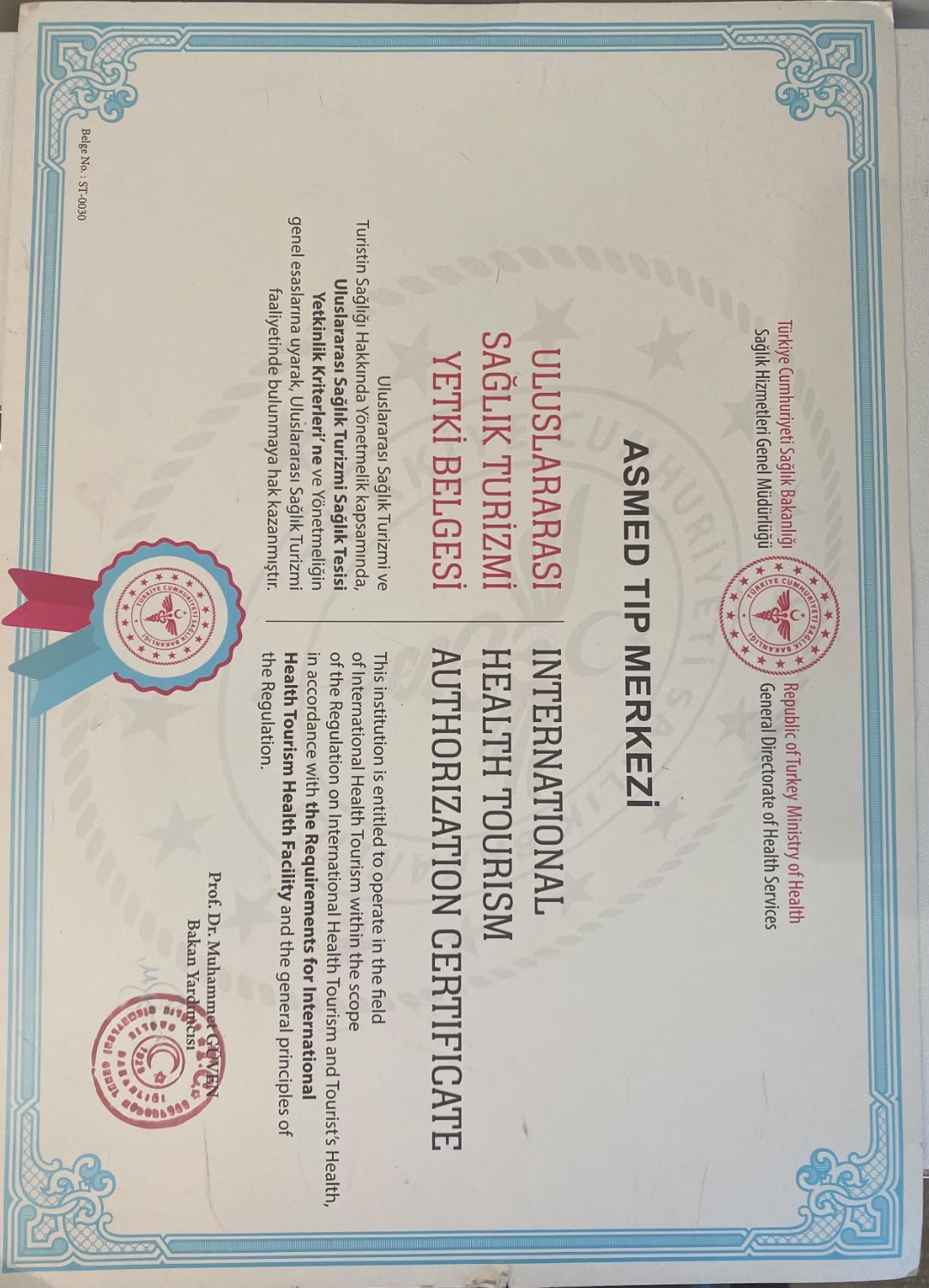
Centro sanitario autorizado para el turismo de salud internacional
ASMED Medical Center es un centro sanitario autorizado por el Ministerio de Sanidad de la República de Türkiye para prestar servicios en el ámbito del turismo de salud internacional.
Propietario y operador: ASMED ÖZEL SAÇ EKİMİ SAĞLIK HİZMETLERİ A.Ş.
N.º de certificado de autorización: ST-0030

Atatürk Mah. Sedef Caddesi No: 1/1 Ataşehir - İstanbul
Cookie Declaration - Update Date: 09.09.2026 - Editor: Ozer Erik - Tel: +90 216 464 11 11